When Your IT Guy Retires: What Australian SMBs Need to Know About the MSP Crisis
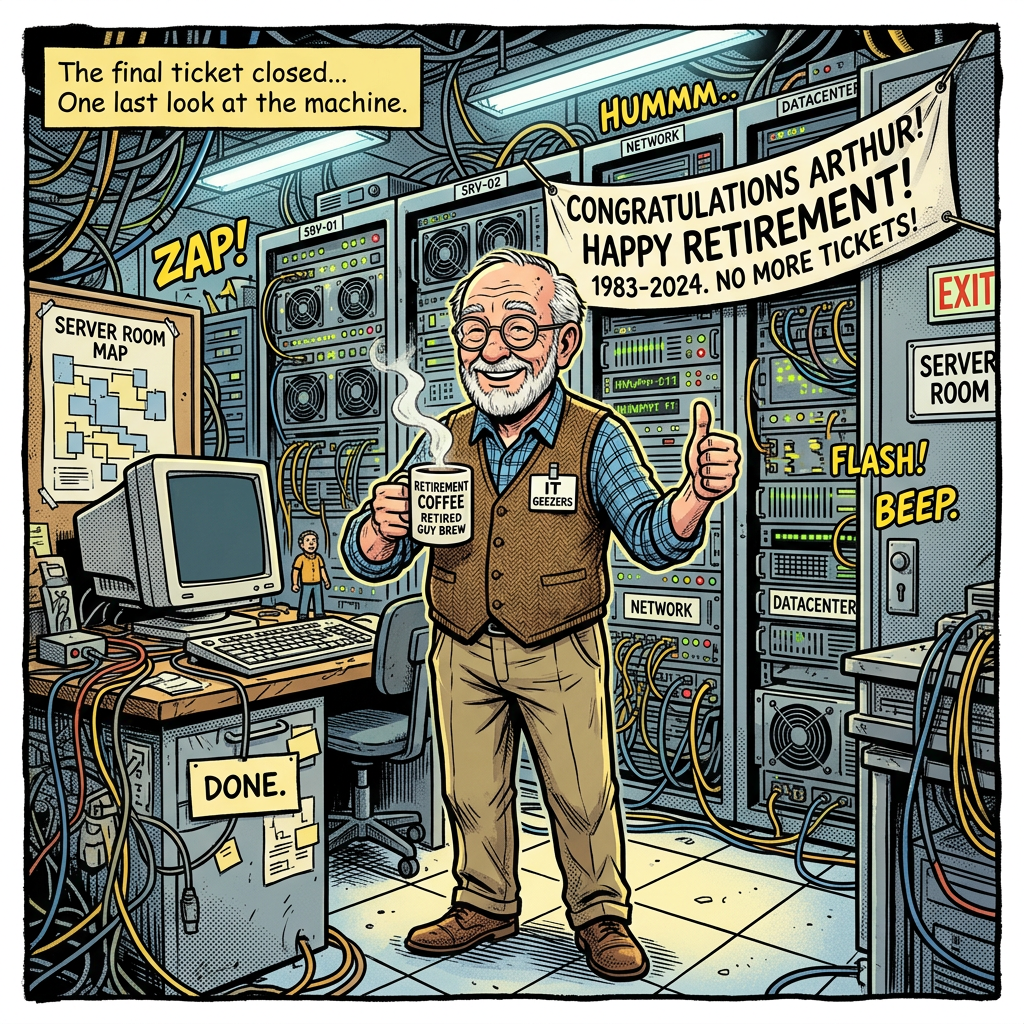
There is a quiet succession crisis building inside Australian IT services, and most small business owners have no idea it’s coming.

Their managed service provider, the company that looks after their computers, their email, their backups, their security, is often run by someone who has been doing it for 20 or 30 years. That person is in their late 50s or 60s. They are thinking about retirement. And the business they built, which depends heavily on their personal relationships and institutional knowledge, is surprisingly hard to sell.

This is not a niche concern. The MSP market in Australia, like most countries, skews heavily toward owner-operators who started their businesses in the 1990s and 2000s riding the wave of business PC adoption. That wave is now cresting into a succession event.

What happens when an MSP sells or closes

There are three typical outcomes when a small MSP exits:

Acquisition by a larger MSP or private equity. This is increasingly the most common exit. Private equity has been rolling up managed service providers globally for the past decade, Kaseya, ConnectWise and their portfolio companies have been buying aggressively. In Australia, the same pattern is playing out at a smaller scale. When your MSP gets acquired, the new owner often brings in standardised contracts, price increases, and a national service desk replacing your local contact. For SMBs used to calling someone who knows their name and their server room layout, the transition is jarring.

The owner retires and closes. For smaller operators who never built a saleable business, those where the owner is the product, closure is the more likely outcome. When that happens, their SMB clients are left scrambling. Passwords in someone’s head. Vendor relationships that evaporate. Backup systems nobody else knows how to restore. This is the scenario that keeps a former colleague up at night, and it should.

The owner transitions the business to AI-augmented services. This is the best outcome for SMBs. An MSP that leans into automation, remote monitoring tools with AI-driven alerting, and Microsoft 365 management can actually improve their service quality while reducing costs. Some will make this shift. Many won’t.

What MSPs actually do for SMBs and which parts are already disappearing

Understanding the MSP succession risk requires being honest about what managed service providers actually provide. It is not a monolithic thing.

The traditional MSP bundle included:

  • Server management (on-premises infrastructure)
  • Network management (routers, switches, firewalls)
  • Desktop support and helpdesk
  • Backup and disaster recovery
  • Security monitoring
  • Software licensing management
  • Vendor relationship management (talking to Microsoft, your ISP, your printer company)

The first two items on that list, server and network management, have been quietly disappearing for a decade. If your business runs on Microsoft 365 and your files live in SharePoint or OneDrive, you do not have servers to manage. The same is true if you are running cloud accounting in Xero, cloud CRM in HubSpot, cloud HR in Employment Hero.

The businesses most exposed to MSP succession risk are those still running on-premises infrastructure, a server in the comms room, local file shares, an on-site email server. Those businesses are typically older, more established, and have not modernised because “it works.” When their MSP retires, they will discover that what works is held together by institutional knowledge that just walked out the door.

The AI factor

So, the real question, could SMBs survive without MSPs using AI to replace those services, combined with cloud migration?

For a significant slice of SMBs, the answer is probably yes, eventually.

Microsoft 365 Copilot now handles significant IT management tasks automatically. Security alerts, access management, compliance monitoring. Google Workspace does similar. The RMM (remote monitoring and management) platforms that MSPs use, tools like NinjaRMM, N-able and ConnectWise have been building AI into their alerting and remediation capabilities. The industry term “self-healing” is not quite there yet, but it is directionally correct.

The gap that AI does not close, and will not close quickly, is judgement. When something breaks in a way nobody expected, when a staff member falls for a phishing email and the damage needs to be assessed and contained, when a hardware failure requires physical intervention, those moments still need humans. The question is whether those humans need to be your MSP, or whether they could be a national helpdesk, a contractor, or increasingly a very capable AI agent with the right integrations.

What Australian SMBs should do about this

Know where your IT actually lives. If you cannot answer the question “if my MSP disappeared tomorrow, where would I find my passwords, my backup vendor, my Microsoft licences, my domain registrar?”, you have a dependency that needs documenting. Ask your MSP for a full IT asset register. Any good operator will provide one willingly. Reluctance to share it is a red flag.

Understand your on-premises exposure. Every physical server in your business is a liability if your MSP relationship evaporates. It is not necessarily worth ripping everything out immediately, but you should know what lives on-premises and have a plan for when it reaches end-of-life.

Find out what your MSP’s succession plan is. This is an awkward conversation, but it is a reasonable one. A professional operator will have thought about this. If they have not, that tells you something.

Move cloud-ward deliberately. Not all at once, and not because cloud is automatically better. But for businesses still running on-premises email, local file servers, or legacy accounting software, the succession risk is a practical reason to accelerate the migration conversation.

Build direct relationships with your key vendors. Microsoft, your internet provider, your backup vendor. Know how to contact them without going through your MSP. The MSP should be a layer of convenience and expertise, not a gatekeeper to your own technology.

The bigger question

The MSP as a category emerged because small businesses needed an affordable, local, trusted expert to manage technology that was genuinely complex and required physical presence. That model made complete sense in 2000.

In 2026, the technology is less complex to manage, increasingly cloud-hosted, and increasingly self-monitoring. The physical presence requirement is lower. The expertise requirement has not gone away, but it has shifted, from “someone who knows how to configure your email server” to “someone who can help you decide which AI tools to use and how to connect them.”

That is a different kind of MSP. Some of the existing ones will make the transition. Many will not.

The succession crisis is real. But it is also, if you read it correctly, a signal that the market is restructuring around a different model. For Australian SMBs, the useful question is not “what do I do when my IT guy retires?” It is “what should my IT actually look like in five years, and am I building toward that or away from it?”